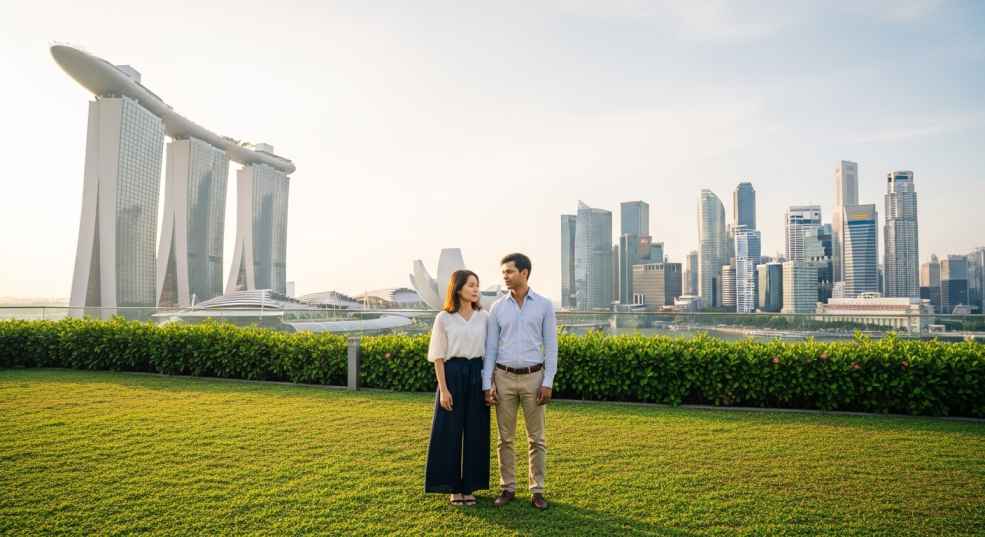
The first thing you notice is the humidity. It wraps around you like a heavy silk blanket the second you walk out of the airport. You see the manicured trees and the orchid displays that give the city its famous nickname. But those perfectly pruned hedges are just the cover of a much more complex book.
After years of calling this island home the polish starts to reveal a deeper soul. You stop looking at the skyline and start looking at the people. You realize that the real Singapore is not found in a luxury mall but in the quiet morning rituals of a neighborhood coffee shop. This is where the expat vs local experience truly begins to merge into one shared reality.
The Silent Language of the Tissue Packet
In most parts of the world a pack of tissues is for a runny nose. Here it is a legal document. Placing a small packet of paper on a table at a crowded hawker center is a sacred act known as choping. It signals to everyone that this seat is taken.
You learn quickly that respecting the tissue packet is among the most vital Singaporean social norms. It represents an unspoken trust. You can leave your belongings and walk away to join a long food queue with total peace of mind. It is a level of safety that feels alien at first but eventually becomes your new baseline for civilization.
Living here long term means realizing that the small rituals of the everyday are far more important than the big spectacles at Marina Bay.
The Pulse of the True Heartland Life
Most visitors stay within the central districts where everything is glass and steel. But true heartland life happens in places like Ang Mo Kio or Bedok. This is where you find the void decks. These are the open ground floors of public housing buildings that serve as the living rooms of the community.
On any given day you might see a wedding celebration at one end and a group of seniors playing checkers at the other. There is a specific rhythm to these spaces that feels grounded and permanent. It is where you see the multi generational families sharing a meal or children racing their scooters. This hidden Singapore is where the island actually breathes.
Expert Insight: One of the best living in Singapore tips is to stop eating at the malls and start following the uncles to the local coffee shops where the coffee costs less than two dollars.
The Efficient Beauty of the Singlish Symphony
You might start your journey here trying to speak perfect English. Within two years you will find yourself adding a sharp “lah” or “can” to the end of your sentences. Singlish is not just broken English. It is a highly efficient linguistic shorthand that blends Mandarin and Malay with English.
It is the great equalizer. When you hear a high powered CEO and a taxi driver using the same local inflections you realize it is a badge of belonging. It bridges the gap between different cultures and backgrounds. Once you stop trying to correct it and start using it you finally feel like you are no longer just a guest.
The Ritual of the Religious Rain
Rain in Singapore is not just weather. It is a daily appointment. Around late afternoon the sky often turns a bruised purple and the heavens open with a ferocity that can be startling. People do not run for cover in a panic. They simply step under a covered walkway and wait.
The city is designed for this. You can walk for miles under protected linkways without ever getting wet. There is a collective pause that happens during these downpours. You watch the lightning and wait for the heat to break. It is a five minute reset for the entire island before life resumes its fast pace.
The Emotional Weight of the Hawker Queue
You will eventually learn that a long line is not a deterrent. It is a recommendation. In Singaporean culture a queue is a sign of quality that cannot be faked. You will see people standing in the heat for forty minutes just for a specific plate of chicken rice.
This patience reveals something about the local character. There is a deep appreciation for craft and tradition. The auntie or uncle who has been cooking the same recipe for forty years is treated with the same respect as a Michelin star chef. Eating here is a serious hobby and joining the queue is your initiation into the local fold.
The transition from visitor to resident happens the moment you prioritize a great bowl of laksa over a fancy brunch.
The Complexity of the Kiasu Spirit
You will often hear the word kiasu which translates to a fear of losing out. It drives much of the ambition and the orderly nature of the city. While it can manifest as rushing for a seat on the train it also drives a constant search for excellence.
Living with this energy for years changes you. You become more punctual and more organized. You start to value the extreme efficiency that makes a city of nearly six million people run like a clock. You realize that the order is what allows the freedom to enjoy life without the chaos found in other global hubs. It is the secret ingredient that makes this tiny red dot so remarkably resilient.